Candice Lyons, Black Star Assistant Professor of Black Studies, University of California Santa Barbara
clyons@ucsb.edu | candicelyons.net
At the 2026 Queer/Trans History Conference I presented on a recent article, in which I utilized pre-Emancipation runaway slave advertisements to trace the gender performances of enslaved self-emancipators escaping or moving throughout the U.S. South. During the Q&A, I linked these fugitives’ stories to that of a formerly enslaved Black trans woman named Frances Thompson, the subject of my forthcoming JWH piece “Frances Thompson, Gender Violence, and Nineteenth Century U.S. Black Women’s Agential Transfemininities.” In response, a member of the audience noted that my invocation of the figure reflects public interest in (and scrutiny of) Thompson dating back to, at least, her 1876 Memphis arrest on ‘crossdressing’ charges; they asked how we as historians might resist the tendency to consolidate our scholarly interest onto individual queer figures like Thompson to the exclusion of other narratives.
My response, as well as my initial impetus for writing this account of Thompson’s life, was that although her story—marked by her historic turn as the first known Black trans woman to testify before Congress, public-facing anti-rape activism, and highly publicized detainment—is exceptional, Frances Thompson was by no means an exception. Rather, my work across projects has sought to underscore the banality of queerness, even and especially in the spaces we may be least inclined to search for it: in the slavehold, on the plantation, and anywhere Black people living in the shadow of bondage were attempting to articulate agency. The move to place Thompson’s narrative in conversation with that of her transfeminine contemporaries Mary Jones and Mary Ann Waters, then, stemmed not from a desire to trace parallels between three outliers, each of whom entered (or re-entered) the archive following arrests that incited public discussions about the ‘truth’ of their genders, but instead to highlight that across time, location, and slave status, Black gender existed as a space of contestation and capaciousness.
In my forthcoming book, the question I return to, chapter by chapter, is how best to write enslaved and free Black people’s varied approaches to gender and sexuality in the pre-Emancipation United States back into contexts in which they have been consistently (and, in some cases, intentionally) written out. The negation of Thompson’s claims to womanhood, orchestrated by journalists, doctors, and law enforcement officials working in conjunction, is echoed in the histories of figures like Jones and Waters, but is also emblematic of attempts at correction and erasure that extended far beyond the experiences of these three women. The runaway slave advertisements to which I earlier alluded are illustrative:
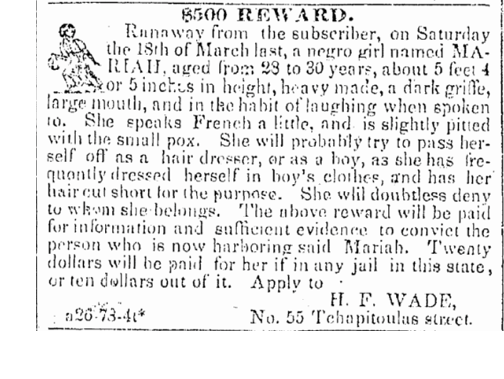
In one such advertisement, published in New Orleans’ Daily Picayune in 1837, an aggrieved enslaver, H.F. Wade, offers a five-hundred-dollar reward for his erstwhile captive Mariah, who had self-liberated from his wife’s boarding house months earlier. Wade’s description limns the fugitive as young, jovial, and bilingual—a seemingly unremarkable portrayal distinguished by the additional disclosure that Mariah would “probably try to pass herself off as a hair dresser, or as a boy, as she [had] frequently dressed herself in boy’s clothes, and [had] her hair cut short for the purpose.”[1] Within Wade’s move to depict Mariah’s gender digression as a ‘passing’ deceit, however, it is possible to detect the escapee’s own attempts at self-determination. In rejecting both enslavement and the institution’s cisnormative impositions, Mariah was seizing a brand of queer agency marked by refusal.
For Frances Thompson, such refusal was undertaken with the seeming knowledge and support of her community. In one of the dozens of articles proceeding her arrest, Thompson is reported to have described her time in bondage, prior to the conclusion of the Civil War, as a period in which she wore “female attire” and was “regarded always as a woman”—details that echo her contemporary Mary Jones’ recollections of being encouraged by associates to dress in “women’s clothes” and attending “parties among the people of [her] own Colour dressed in this way.”[2] Though the press narrated both figures as anomalies, this framing reflects a hegemonic perspective out of step with the two’s lived realities. In the interstices of history—within stories of escape marked by vestiary mobility, or the subversive divulgences of free, enslaved, and emancipated gender insurgents—a richer, more varied picture begins to emerge, one that positions queerness not as aberrant, but iterative.
NOTES
[1]. H.F. Wade, “$500 Reward,” The Daily Picayune (New Orleans, Louisiana) June 3, 1837, https://fotm.link/32876872-f1a7-48c2-b3d9-3d668da3c6eb.
[2]. “Frances Thompson,” The Memphis Daily Appeal, July 14, 1876, Accessed July 30, 2026, https://www.digitaltransgenderarchive.net/files/wh246s47c. C. Riley Snorton, Black on Both Sides: A Racial History of Trans Identity (Minneapolis, MN: University of Minnesota Press, 2017): 60.
