Personal Connections in the Search for the Women of the Black Panther Party
Marissa J. Spear
In my senior year, with support from the Brooke and Carol Peirce Fellowship I began my thesis research on the Baltimore branch of the Black Panther Party in the Goucher College Special Collections and Archives. By then, I had worked for some time in the archives, so I knew there would be certain collections rich in material–the Herman Heyn Papers and Protest Movement Collection and the Women’s International League for Peace and Freedom (WILPF) Baltimore Chapter Collection. But still, with everything I knew about the history of Goucher, a predominantly white institution and historically a women’s college with a complicated relationship with Baltimore, I was skeptical about how rich the material would be.
Like many other Black Panther Party chapters and branches across the country, the Baltimore branch relied on the sale of the Black Panther, donations, and various speaking engagements for income. Baltimore Panthers were invited to speak at a number of local colleges and universities, including Catonsville Community College, Community College of Baltimore, Coppin State College, Frostburg State College, Johns Hopkins University, Morgan State College, and University of Maryland College Park.[i] I had a hunch that the Panthers spoke at Goucher too, although it was not listed in any source material I had read. Maybe it was just wishful thinking on the part of an undergraduate student hoping to find a gem in the archives. Either way, I set out digging through back issues of the Goucher Weekly, the student newspaper at the time. As I sat at the large tables, flipping through pages of the bounded copies, I came across a March 1969 issue with an article titled “Black Panthers Advocate Revolution” (see image 1). My hunch had proven true after all.
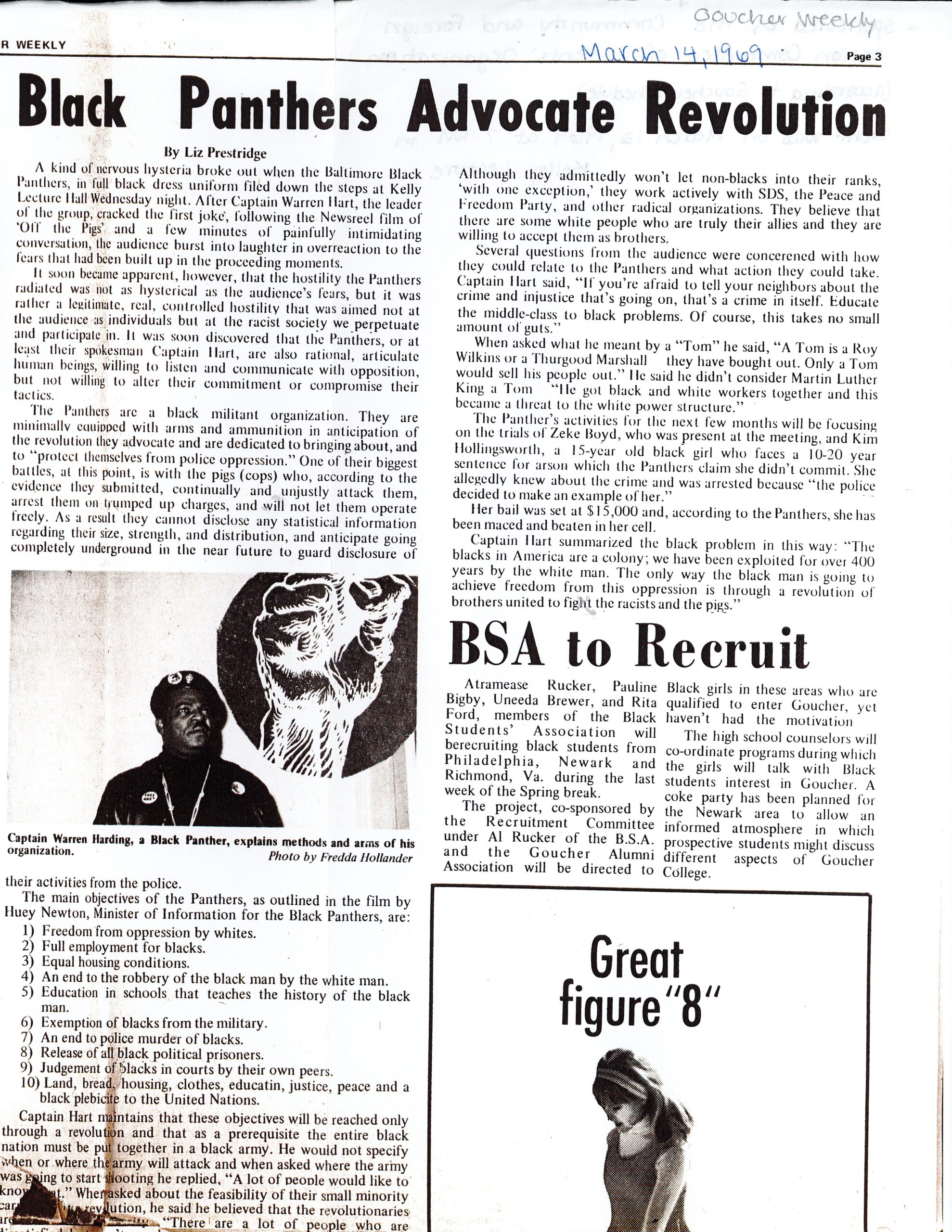
Image 1. Scanned issue of the Goucher Weekly with the March 1969 article “Black Panthers Advocate Revolution”.
The article’s opening line states: “A kind of nervous hysteria broke out when the Baltimore Black Panthers, in full black dress uniform filed down the steps at Kell[e]y Lecture Hall Wednesday night.”[ii] At that point, I had spent so much time reading about the Baltimore Panthers and, yet, it was striking in a new way to see them come alive on the small campus I had walked everyday for the past three years. Kelley Lecture Hall was where I took my Introduction to Women, Gender, and Sexuality course. This added sense of place would come to inform further work I conducted on the Baltimore Panthers, walking the neighborhoods where they organized, and co-creating a zine as part of my thesis presentation, which included a map of Baltimore Panther organizing over their four years from 1968 to 1972.
Unsurprisingly, the Goucher Weekly, like similar predominantly white news outlets of its time, exaggerated Panther rhetoric, which worked to delegitimize Panther efforts.[iii] For instance, the article describes how “the hostility the Panthers radiated was not as hysterical as the audience’s fears.”[iv] The rest of the sentence goes on to name accurately that the Panther “hostility” was not aimed at the audience, but at the “racist society we perpetuate and participate in.”[v] However words like “hostile” and “hysterical” played into the prevailing narrative that the Panthers were an organization white people should fear. Later on, the article states with almost surprise that the Panthers are “rational, articulate, human beings.”[vi] It bears mentioning that the Goucher speaking engagement was led by founder of the branch Captain Warren Hart, who was later revealed to be an informant for the federal government. Still, the sensationalism of Panther words and actions in white news media was not uncommon.
Throughout the branch’s four-year tenure in Baltimore, there were a number of organizations and collectives, both Black and white, that supported the work of the Panthers. One of those collectives was the Baltimore Committee for Political Freedom (BCPF), a group of radical academics and individuals from the local religious community. One of their members was Dr. Joseph Morton, philosophy professor, peace activist, and founder of the Goucher Peace Studies Department, whose papers now reside at Goucher. In 1995, Morton began corresponding with former Philadelphia Panther and political prisoner Mumia Abu-Jamal. I knew Mumia’s involvement in the Philadelphia Panthers probably had little to no crossover with the Baltimore branch but, still, it felt like another personal connection–letters from a man responsible for starting the Goucher department where I did most of my coursework to one of the most famous political prisoners in history.
I remember that day in the archives vividly, reading through their exchange. Reading felt simultaneously heavy and sacred in a way many of my interviews with former Panthers did. It was important to me to honor the time and words activist elders shared with me. There was a line from one of Mumia’s letters that I carry with me: “This I’ve learned – No action, no matter how seemingly insignificant, is without effect in this universe. In that connection, consider: Is a man truly ‘dead’ when thousands read the words of his heart, or tens of thousands hear his words echoing in their consciousness?” (see image 2)[vii]
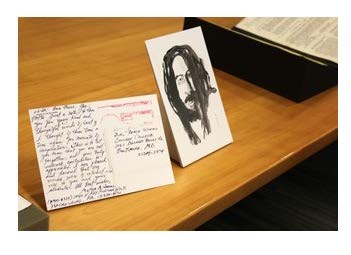
Image 2. Picture of copies of correspondence between Dr. Joseph Morton and Mumia Abu-Jamal on display at author’s thesis defense in 2017.
Eventually, I wrote my own letter to Mumia. I was moved by his response (by the fact that he even responded), and was touched by his shared memories of Steve McCutchen, a Baltimore Panther I had interviewed as part of my research.
Ultimately, the Goucher-specific discoveries I made during my research were surprisingly some of the most rewarding, maybe because they were the ones I had never set out to find. Though they were not integral to my eventual article in the Journal of Women’s History, they make up threads that paint a fuller picture of the Baltimore branch. More to the point, they were intensely personal threads that had a direct impact on my political coming-of-age at Goucher College.
NOTES
[i] Judson L. Jeffries, “Revising Panther History in Baltimore” in Comrades: A Local History of the Black Panther Party (Indiana University Press, 2007), 24.
[ii] Liz Prestridge, “Black Panthers Advocate Revolution,” Goucher Weekly, March 14, 1969, 3. Goucher College Student Newspaper Collection, Goucher College Special Collections and Archives, Goucher College, Baltimore, MD.
[iii] Jane Rhodes, Framing the Black Panthers: The Spectacular Rise of a Black Power Icon (University of Illinois Press, 2017), 115.
[iv] Prestridge, “Black Panthers Advocate Revolution,” 3.
[v] Prestridge, “Black Panthers Advocate Revolution,” 3.
[vi] Prestridge, “Black Panthers Advocate Revolution,” 3.
[vii] “Correspondence with Mumia Abu-Jamal,” MS 0030, Box 7, Folder 119, Joseph Morton Papers, Goucher College Special Collections and Archives, Goucher College, Baltimore, MD.
