Gender, Media and Elder Care
Eric Covey, Grand Valley State University
When I initially submitted my article to the Journal of Women’s History, I closed by drawing a comparison between what happened at the Bethesda Home in 1908 and events following Hurricane Harvey in Texas that August 2017. In the immediate aftermath of the destructive flooding of Houston and elsewhere, two nursing home dramas played out in the news and on social media–in the same fashion that the drama at the Bethesda Home played out in the pages of the Chicago Tribune. The first drama took place at La Vita Bella, an assisted living facility in Dickinson, Texas. A picture posted by Twitter user @DividendsMGR showed eight women and a cat going about their business in a living room where the water was waist-deep.
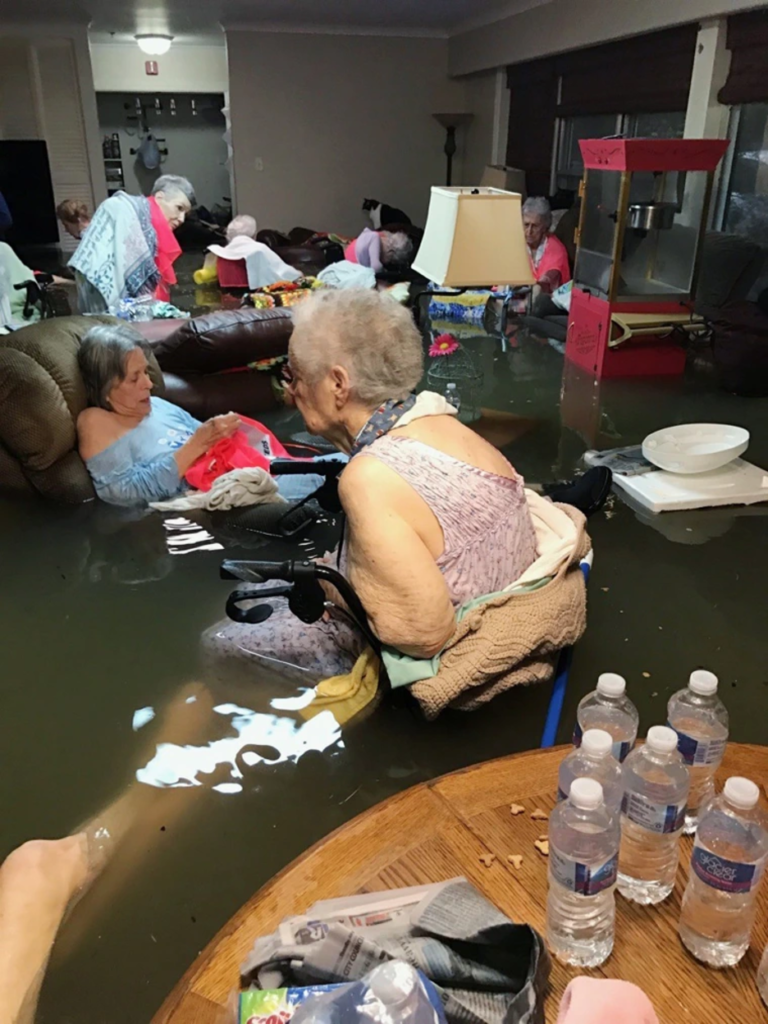
Meanwhile in Port Arthur, farther east on the Texas coast, a drama much larger in scope was taking place. Lake Arthur Place and Cypress Glenn, two care facilities operated by Senior Care Centers, flooded and residents were in need of evacuation. A reporter from KFDM was on scene at Lake Arthur Place, calling it “the worst I’ve seen so far.” News and social media reports described La Vita Bella and Lake Arthur Place both as nursing homes, but the two facilities are actually quite different. While La Vita Bella–an assisted-living facility–had only fifteen residents, all white women, as the viral photo clearly showed, Lake Arthur Place–a long-term care facility–was home to about seventy residents and the KATV live report showed bedridden patients in the hall and many African Americans. Administrators at Lake Arthur Place also appeared to refuse permission for rescuers to remove residents, preferring corporate accountability to the pleas to load the residents onto waiting boats. As rescuers loaded one resident (a woman whose family was there to give consent to evacuate) onto a boat, a rescuer asks, “Does he [the head administrator of the facility] understand the severity of it?” Someone off camera responds, “No.” The rescuer responds, “The National Guard isn’t coming.”
Later, on their Facebook page, Senior Care Centers reported that “We fully cooperated with the Department of Aging and Disability Services and the local authorities with yesterday’s evacuation.” They also assured families who could not locate their relatives that they were in the process of locating all the evacuated residents. But according to a report from the Port Arthur Times on the investigation that followed, when police arrived to evacuate residents, the director refused, an altercation ensued, and he had to be placed in handcuffs while the facility was evacuated. A two-year criminal investigation followed along with numerous civil complaints. Ultimately, it appears that neither the owners of La Vita Bella nor Senior Care Centers had plans in place to evacuate residents in the case of an emergency. Further echoing events at the Bethesda Home from 1908, little attention was paid to caregivers in Dickinson or Port Arthur in 2017. At Lake Arthur Place, employees appeared wary about being caught on camera, though one nurse did ask for help getting the residents out. And another woman, dressed in street clothes, is seen helping to load the evacuating woman onto a boat. It is unclear if she is a relative or an out-of-uniform employee of the facility. While the cost of caring for older adults has–to a large degree–been shifted from individuals and local charities to the wider public since the Bethesda Home bankruptcy in 1908, institutional spaces remain isolated from larger social discourses because care is administered by private, rather than public, entities. Four years after Hurricane Harvey, the Covid pandemic has presented innumerable examples of the devastating effects of segregating older adults from the population at large and allowing private, for-profit companies to oversee them. Rather than protecting them from the virus, nursing homes became killing centers for older adults as my recent bookmarks show.
The New York Times continues to report on former New York Governor Andrew Cuomo’s attempts to cover up the death toll in the state’s nursing homes. And the FBI also opened an investigation into his efforts to shield the industry and its executives from criminal and civil liability.
Now, as I write this in late August, 2021, I sit in Michigan wondering what will happen to older adults along the Gulf Coast who were not evacuated and are perhaps trapped–once more–in flooded nursing homes following Hurricane Ida. I am reminded of Sheri Fink’s 2009 investigation into events at Memorial Medical Center in New Orleans. In the midst of that human catastrophe, doctors and nurses chose to kill patients who they thought would be impossible to evacuate from the hospital. In their cruel actions, critical observers can see the intersections of anti-Blackness, fatphobia, and ageism. I worry that as more reports emerge about nursing homes during Hurricane Ida and Covid, there will be more stories of death caused by the historical formation of institutionalized care.

